

While many organizations begin with traditional fully insured coverage, growing healthcare costs have led more employers to explore funding alternatives such as level-funded plans and group captive programs. While the two options may look similar on the surface, there are important distinctions that employers should know.
Let’s look at how the options compare:
How It Works: A fully insured health plan is the traditional approach to employee benefits. Employers pay a fixed monthly premium to an insurance carrier, which assumes responsibility for paying covered claims. The insurer keeps the profits if claims are lower than expected.
Advantages
Considerations
Best For: Employers seeking simplicity, predictability, and minimal administration

How It Works: Level-funded plans combine aspects of fully insured and self-funded plans, but don’t deliver the full benefits of either approach. The benefits of a level-funded plan, such as flexibility, transparency, and financial opportunity, vary by carrier and program design.
Employers pay a fixed monthly amount that bundles estimated claims costs, administrative fees, and stop loss insurance. If claims are lower than expected, employers may receive a credit applied to next year’s premiums or a partial refund.
Advantages
Considerations
Best For: Employers seeking greater transparency and potential savings while maintaining a predictable funding structure.
How It Works: Group captive programs provide smaller and midsize employers with all of the advantages of self-funding, plus the size and scale of a large company.
Multiple employers share a portion of their health plan risk through a collaborative structure while maintaining many of the advantages associated with self-funding. By pooling risk with other employers, members can reduce volatility, gain collective purchasing power, and benefit from the program’s size and scale.
Advantages
Considerations

Best For: Employers seeking a long-term healthcare financing strategy that provides greater transparency, flexibility, and opportunities for cost management.
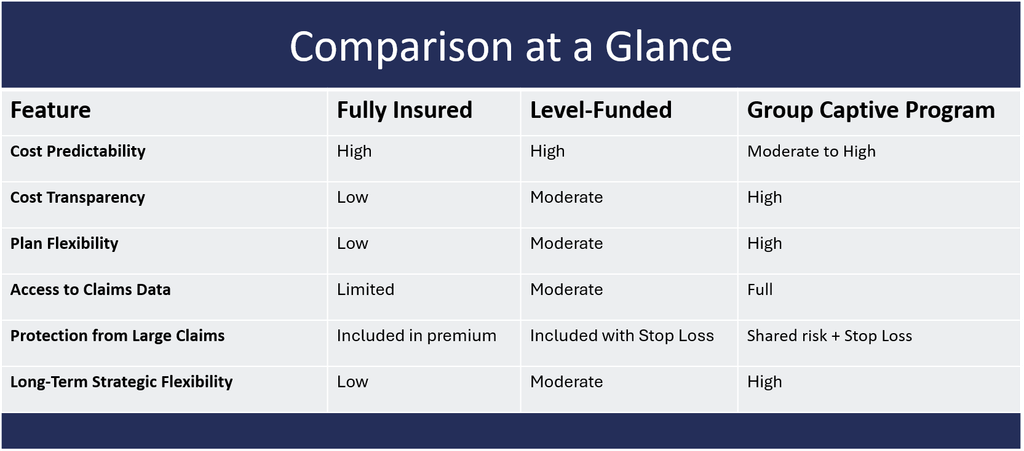
No single funding strategy is right for every employer. Fully insured plans offer simplicity and predictable monthly budgeting, but lack transparency, choice, and control.
Level funding offers more data visibility than traditional fully insured plans, but many employers find it doesn’t offer the control and flexibility needed to manage healthcare costs over the long term.
Self-funding through a group captive program gives small and midsize employers access to similar funding strategies used by many Fortune 500 companies. It’s the best of both worlds. Employers gain the flexibility and control needed to lower healthcare costs, but with the added stability and lower volatility of a much-larger risk pool.
Stop Loss is underwritten by Berkley Life and Health Insurance Company and/or StarNet Insurance Company, both member companies of W. R. Berkley Corporation and rated A+ (Superior) by A.M. Best, and involves the formation of a group captive insurance program that involves other employers and requires other legal entities. Berkley and its affiliates do not provide tax, legal, or regulatory advice concerning EmCap. You should seek appropriate tax, legal, regulatory, or other counsel regarding the EmCap program, including, but not limited to, counsel in the areas of ERISA, multiple employer welfare arrangements (MEWAs), taxation, and captives. EmCap is not available to all employers and may not be available in all states. Payment of claims under any insurance policy issued shall only be made in full compliance with all United States economic or trade and sanction laws or regulation, including, but not limited to, sanctions, laws and regulations administered and enforced by the U.S. Treasury Department’s Office of Foreign Assets Control (“OFAC”).
BAH AD 2026-229