

The theme of the 2026 Berkley Captive Symposium is Blueprints for Better Living: Captive Programs in the Age of Wellness. At this year’s Symposium, our speakers will explore the impact of longevity science, environmental health, and healthy eating on employees and how Group Captive programs can play a role in creating positive incentives for better living.
Employee health and well-being should particularly interest employers with self-funded health plans. There are two ways to reduce the long-term cost of health care: retain more risk and improve the quality of that risk. In our Leveraged Trend article, we addressed the benefits of retaining more risk. This article will dive into the second option – improving the quality of the self-funded health risk.
Improving the quality of employee health risk is not a simple, short-term task. It can be difficult for employers to track and evaluate. Nevertheless, encouraging the prevention, early detection, and clinical management of serious health conditions is a win-win for employers and employees alike. Let’s first take a look at some of the options, then discuss tactics that employers can use to improve wellness programs.
Wellness programs fall into four major categories:
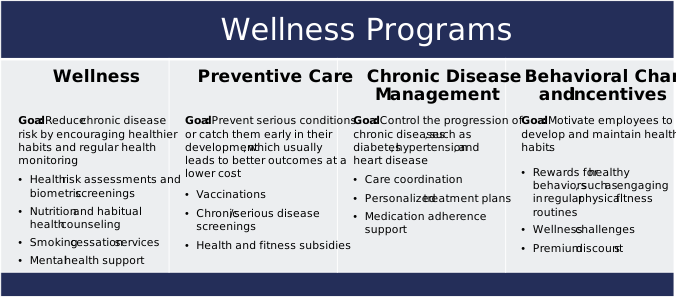
While this is by no means an exhaustive list, it’s a good framework for employers to start thinking about their own wellness efforts.
Behavioral economics gives employers a strong framework for understanding how incentives shape employee engagement with wellness programs. People often fail to act in their long-term best interest because of present bias, inertia, and limited attention. Well-designed incentives can help overcome these barriers, especially when they follow established best practices.
What behavioral science says about employee engagement:
1 RAND Corporation, Research Brief: Incentives for Workplace Wellness Programs, 2015, https://www.rand.org/pubs/research_briefs/RB9842.html
2 RAND Corporation, Research Brief: Incentives for Workplace Wellness Programs, 2015, https://www.rand.org/pubs/research_briefs/RB9842.html
3 Kahneman and Tversky, Prospect theory: An analysis of decision under risk, Econometrica, 47(2), 263–291, 1979, https://doi.org/10.2307/1914185
4 Miller, Do Wellness Programs Work?, Harvard Medical School, https://hms.harvard.edu/news/do-wellness-programs-work
5 National Bureau of Economic Research and University of Chicago, What Do Workplace Wellness Programs Do? Evidence from the Illinois Workplace Wellness Study, https://www.nber.org/system/files/working_papers/w24229/w24229.pdf
This research suggests that employers should:
Time horizon remains a major challenge. Most programs show measurable results only after three to five years. Employers with high turnover or large seasonal or temporary workforces rarely realize meaningful ROI. In contrast, organizations that take a long-term approach to managing their health risk can see concrete benefits. When employers structure programs effectively and offer clear incentives and support, long-term impacts become more likely.
Measuring ROI also proves difficult. While long-term reductions in total cost of risk (TCOR) seem plausible under stable conditions and strong incentive structures, employers cannot easily predict the size, timing, or drivers of those gains. Individual and local factors strongly influence TCOR outcomes, making simple ROI formulas unreliable.
Health conditions further complicate the picture. Many high-impact conditions stem from intertwined environmental and lifestyle factors. Because health outcomes involve complex interactions, simple interventions rarely produce significant change. Effective programs must apply evidence-based, medically sound approaches.
Employers cannot credibly prove that long-term wellness programs will reduce their overall health care costs or deliver positive ROI over time. This limitation reflects the difficulty of proof, not a lack of belief in the underlying logic.
The U.S. Department of Labor and the U.S. Department of Health and Human Services sponsored one of the leading studies on workplace wellness programs. The study found that:
The study is worth reading and provides a good base for thinking about your company’s workplace wellness program.
Read more: Workplace Wellness Programs Study: Final Report | RAND
While no predictive model is perfect, it is possible to identify which health conditions are most likely to occur by looking at employee demographics and historical data. This is essentially what health insurers do when pricing an insurance policy.
By identifying the most likely conditions, employers can focus on targeted screenings. While outcomes are never guaranteed, early detection can lead to simpler, shorter, and less intensive treatment. This can reduce the need for hospital stays and advanced therapies. For example, removing a cancerous polyp during a routine colonoscopy is far less costly and invasive than treating advanced cancer later on. Earlier care often leads to better outcomes and lower overall costs.
A real-world example illustrates this clearly. Color Health published a study showing that lung cancer detected at Stage 1 versus Stage 4 increased five-year survival rates by eight times and reduced average treatment costs by approximately $300,000:

Source: Color Health, Lung cancer: The most preventable deadly cancer, Jan. 28, 2026, https://www.color.com/blog/lung-cancer-the-most-preventable-deadly-cancer/
1 PubMed Central, BMC Health Services Research, Increased healthcare costs by later stage cancer diagnosis, McGarvey et al, Sept. 13, 2022, average cost increase per cancer stage for colorectal, breast, cervical, lung, and prostate cancer, weighted to account for incidence by cancer type, https://pmc.ncbi.nlm.nih.gov/articles/PMC9469540/#:~:text=Among%20members%20diagnosed %202016%E2%80%932020,to%20stages%20I%20and%20II; adjusted to 2025 costs.
2 American Cancer Society, Cancer Facts and Figures 2025, https://www.cancer.org/content/dam/cancer-org/research/cancer-facts-and-statistics/annual-cancer-facts-and-figures/2025/2025-cancer-facts-and-figures-acs.pdf, five-year relative survival rates (%) by stage at diagnosis.
For self-funded employers, the upside of early identification or prevention of large health claims is significant. If large health claims are not prevented, the downside for employers is limited to the wellness program costs and incentives.
Most health plan expenses are routine and fall below the Specific Stop Loss deductible. However, a single high-dollar claim can significantly affect overall costs. For self-funded plans in particular, this makes risk quality especially important. Retaining more risk places greater emphasis on managing that risk effectively. Reducing the likelihood of high-cost claims strengthens the long-term sustainability of the health plan.
The financial impact of long-term wellness initiatives will vary based on the organization and its employee population. However, program costs are generally fixed, while the potential upside can be substantial – both in lowering total risk over time and in smoothing year-over-year spending – making it a smart bet.
Participation and health outcomes can be further improved using thoughtful incentive structures that encourage employee engagement. Behavioral economics has much to teach about the best ways to structure wellness programs.
For self-funded employers, any gains in their health risk quality will translate directly into lower claim costs and measurable savings for the plan.
Coverage is underwritten by Berkley Life and Health Insurance Company and/or StarNet Insurance Company, both member companies of W. R. Berkley Corporation and both rated A+ (Superior) by A.M. Best. Not all products and services may be available in all jurisdictions, and the coverage provided is subject to the actual terms and conditions of the policies issued. Payment of claims under any insurance policy issued shall only be made in full compliance with all United States economic or trade and sanction laws or regulation, including, but not limited to, sanctions, laws and regulations administered and enforced by the U.S. Treasury Department’s Office of Foreign Assets Control (“OFAC”).
BAH AD 2026-105